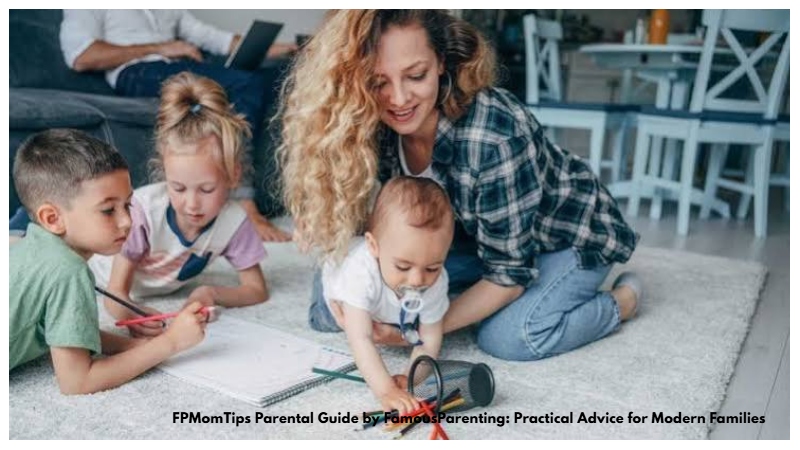
Parenting rarely goes exactly according to plan. One day everything seems organized, and the next brings a difficult bedtime, a missed routine, or a child struggling with emotions. For many parents, the challenge is not finding parenting information—it is finding advice that feels practical enough to use in real family life.
The FPMomTips parental guide by FamousParenting is presented as a practical framework for handling everyday parenting challenges. Its main themes include communication, consistency, emotional development, positive discipline, routines, family relationships, and parental well-being. Rather than suggesting that parents follow one rigid formula, the guidance encourages families to adjust strategies according to their children’s needs and circumstances.
What Is the FPMomTips Parental Guide?
FPMomTips is described as a parenting resource that aims to make family life easier through straightforward advice and manageable strategies. The material associated with FamousParenting covers different stages of childhood, from newborn and toddler care to school-age development and family relationships.
A recurring idea is that good parenting is not about achieving perfection. Instead, parents can focus on creating a safe and supportive environment, communicating clearly, setting reasonable boundaries, and responding to children with patience.
That approach is particularly useful for busy families because it focuses on small habits that can be incorporated into normal routines.
The Core Principles of FPMomTips
Several principles appear repeatedly throughout the FPMomTips guidance.
Safety Comes First
Children need a safe environment in which they can explore and develop. The guide highlights safety checks and age-appropriate considerations as part of everyday parenting, particularly during infancy and early childhood.
For parents, this means paying attention to the child’s surroundings rather than relying only on rules. A quick check of a sleeping area, play space, or outdoor environment can prevent avoidable problems.
Consistency Creates Security
Children often respond better when expectations are predictable.
If a household has a rule about bedtime, screen use, or respectful behavior, parents can make the rule easier to understand by applying it consistently. Constantly changing expectations can leave children unsure about what is acceptable.
Consistency does not mean being rigid. Families can adjust their routines when circumstances change while still maintaining a clear sense of what matters.
Communication Builds Cooperation
FPMomTips places considerable emphasis on communication between parents and children. The underlying idea is that children are more likely to cooperate when they feel heard and understand what is expected of them.
Instead of immediately reacting to difficult behavior, parents can ask questions, listen to the child’s perspective, and explain boundaries in simple language.
A child does not have to get their way simply because a parent listens. Listening and setting limits can happen at the same time.
Helping Children Understand Their Emotions
Children are still learning how to recognize and manage emotions. Anger, frustration, fear, disappointment, and excitement can sometimes appear as challenging behavior because young children do not always have the vocabulary or self-control to explain what they are experiencing.
The FPMomTips approach emphasizes emotional awareness and encourages parents to help children identify their feelings.
For example, instead of simply saying, “Stop crying,” a parent might acknowledge the emotion:
“You’re upset because we have to leave. I understand. It’s still time to go.”
This response recognizes the child’s feelings without removing the boundary.
Over time, conversations like these can help children develop a better understanding of their emotional experiences.
Positive Discipline Without Constant Punishment
Discipline is one of the most difficult parts of parenting because children inevitably test limits.
FPMomTips emphasizes calm boundaries, specific praise, and consistent responses rather than relying primarily on harsh punishment or lengthy lectures.
A practical approach might look like this:
- State the expectation clearly.
- Explain the limit in age-appropriate language.
- Acknowledge the child’s feelings.
- Follow through with a reasonable consequence when necessary.
- Notice and praise positive behavior.
For example, if a child repeatedly interrupts another person, a parent can calmly remind them to wait for their turn. When the child eventually does so, recognizing that behavior reinforces the lesson.
The objective is not simply to stop unwanted behavior. It is to help children gradually develop better ways of handling situations.
Creating Routines That Actually Work
Family routines can reduce daily uncertainty. Regular patterns around meals, sleep, school preparation, homework, and play can help children know what comes next.
The FPMomTips material recommends simple routines rather than complicated schedules that are difficult to maintain.
A morning routine, for example, might involve:
- Getting dressed.
- Eating breakfast.
- Brushing teeth.
- Packing school items.
- Leaving at a consistent time.
The exact routine will depend on the child’s age and the family’s schedule. What matters most is creating a predictable structure that makes everyday tasks easier.
Supporting Toddlers Through Play
Play is more than entertainment for young children. It provides opportunities to explore language, movement, problem-solving, imagination, and social interaction.
The FPMomTips guidance highlights simple play-based activities such as sorting, stacking, pretend play, and naming objects during everyday activities.
Parents do not need expensive educational toys to support development. Everyday objects and ordinary family activities can become learning opportunities.
Talking to a toddler while preparing food, for example, can introduce words, colors, textures, and simple concepts. Sorting laundry or putting toys away can also become a basic lesson in matching and organization.
Helping School-Age Children Build Good Habits
As children enter school, parenting responsibilities often shift. Homework, friendships, screen use, extracurricular activities, and increasing independence become more important.
FPMomTips recommends establishing structured homework routines and creating a suitable environment for schoolwork. It also discusses balanced screen habits and social skills such as listening, taking turns, and apologizing.
Parents can support these habits without taking complete control of the process.
For example, instead of doing homework for a child, parents can provide a quiet place to work, help with organization, and encourage the child to attempt problems independently.
This combination of support and independence helps children gradually take more responsibility for their own tasks.
Managing Screen Time Thoughtfully
Screens are part of modern family life, so completely avoiding technology may not be realistic for many households.
The FPMomTips material suggests creating clear screen rules and establishing screen-free periods, including during meals and before bedtime.
Rather than focusing only on the number of minutes a child spends on a device, parents can also consider what the child is doing, when they are using the device, and whether screen use is interfering with sleep, schoolwork, physical activity, or family interaction.
The right approach can vary according to age and family circumstances.
Building Stronger Family Relationships
Parenting is not only about managing behavior. Relationships matter just as much.
FPMomTips encourages families to make time for meaningful interaction, family conversations, traditions, and shared activities.
These moments do not need to be elaborate.
A family meal, short walk, weekend activity, bedtime conversation, or regular game night can give parents and children opportunities to connect without focusing on chores or discipline.
Small moments repeated over time can become some of the strongest parts of family life.
Parents Need Support Too
Parenting advice often focuses heavily on children, but parents have needs as well.
The FPMomTips approach includes parental well-being, co-parenting cooperation, household responsibilities, and asking for help when necessary.
Parents may find it useful to divide household tasks according to schedules and strengths rather than assuming that one person should handle everything.
Even a short weekly conversation about upcoming responsibilities can prevent misunderstandings.
Most importantly, asking for support should not be viewed as failure. Family members, trusted friends, community resources, and qualified professionals can all have a role when parents need additional help.
Avoiding Common Parenting Traps
No parenting guide can eliminate difficult days, but recognizing common mistakes can make them easier to handle.
Some habits worth watching include:
- Comparing siblings or children with their peers.
- Changing rules from one day to the next.
- Reacting strongly to every minor mistake.
- Ignoring a child’s emotional needs.
- Expecting children to behave like adults.
- Trying to maintain unrealistic standards of perfection.
The FPMomTips material repeatedly returns to the idea that parenting should be adaptable. Different children have different personalities, developmental stages, and needs, so a strategy that works for one family may not work exactly the same way for another.
How to Use FPMomTips in Everyday Life
Parents do not need to adopt every recommendation at once.
A better approach is to identify the family’s biggest current challenge and start there.
When mornings become chaotic, prepare a simple routine the night before.
Whenever communication gets difficult, set aside a few minutes each day for an uninterrupted conversation.
For inconsistent discipline, establish a few clear household rules and agree on how they should be handled.
Whenever the entire household feels overwhelmed, identify responsibilities that can be shared or simplified.
Small changes are usually easier to maintain than a complete overhaul of family life.
Is the FPMomTips Guide Right for Every Family?
No parenting framework can perfectly match every household.
Children differ in temperament, age, personality, developmental needs, and circumstances. Family structures and cultural expectations also vary widely.
That is why the most useful way to view FPMomTips is as a collection of ideas rather than a strict rulebook.
The FPMomTips website itself notes that its material is intended for general informational and educational purposes and should not be treated as professional medical, psychological, or legal advice.
When a child has significant health, developmental, behavioral, or emotional concerns, parents should seek guidance from an appropriately qualified professional.
Final Thoughts
The FPMomTips parental guide by FamousParenting takes a practical view of modern parenting. Its central themes—communication, consistency, emotional awareness, positive discipline, routines, family connection, and parental well-being—are designed to help parents handle ordinary challenges without chasing an unrealistic idea of perfection.
Perhaps the most useful lesson is that effective parenting is built through everyday interactions. A calm response during a tantrum, a few minutes of genuine conversation, a predictable bedtime routine, or a simple word of encouragement may seem insignificant in isolation. Over time, however, these small actions can help create a home where children feel safe, understood, and supported.
Parenting will always involve uncertainty. The goal is not to get everything right. It is to keep learning, stay connected, and make thoughtful choices that fit the needs of your own family.
This version is written to target the primary phrase “FPMomTips parental guide by FamousParenting” naturally, while also covering related SEO terms such as FPMomTips parental advice, positive parenting, parenting tips, family communication, and parental guide FPMomTips.